Pyrroloquinoline Quinone (PQQ): A Breakthrough in REDOX Biology
Discovery & Significance
Discovered in 1979 by Japanese researchers, PQQ is a water-soluble quinone and the third known REDOX coenzyme, following NAD⁺/NADP⁺ and FMN/FAD. It plays a crucial role in cellular respiration and electron transport, working synergistically with Coenzyme Q to enhance mitochondrial efficiency. Studies show PQQ’s redox activity is 100–1000 times more potent than vitamin C, isoflavones, or polyphenols.
Biological Function
PQQ supports:
- Mitochondrial biogenesis and function
- Antioxidant defense
- Neuroprotection
- Cellular energy metabolism
Its unique properties have been highlighted in leading journals such as Nature and Science, affirming its value in nutrition and pharmacology.
Antioxidant Mechanisms of PQQ
Enhancement of Mitochondrial Function
PQQ upregulates the expression of peroxisome proliferator-activated receptor-γ coactivator 1α (PGC-1α), a key regulator of mitochondrial biogenesis. This promotes the proliferation of mitochondria and increases the activity of essential mitochondrial enzymes such as citrate synthase and cytochrome c oxidase. By improving mitochondrial efficiency, PQQ helps reduce oxidative stress resulting from mitochondrial dysfunction.
Regulation of Antioxidant Enzymes
PQQ binds to Cu/Zn superoxide dismutase (SOD), inducing conformational changes that enhance the enzyme’s ability to scavenge reactive oxygen species (ROS). This strengthens the body’s defense against oxidative damage at the cellular level.
Sources and Distribution
In Foods
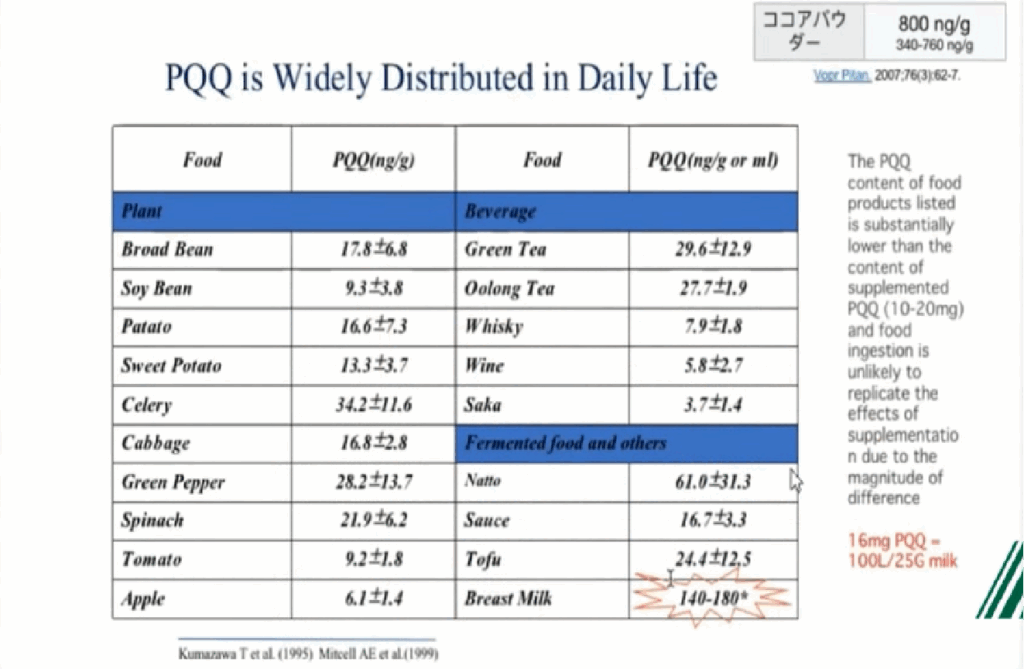
PQQ occurs naturally in fruits, vegetables, grains, and beverages, with concentrations ranging from 3.65 to 61 ng/mL.
In the Human Body
Detected in red blood cells, cerebrospinal fluid, synovial fluid, bile, and most abundantly in breast milk (140–180 ng/mL), suggesting a vital role in early development and mitochondrial health.
Supplementation and Market Use
Because PQQ is not synthesized by the human body and is found only in trace amounts in food, it is typically consumed through:
- Nutritional supplements
- Functional foods
- Health care products
PQQ and Brain Health: Enhancing Mitochondrial Performance
Healthy mitochondria are essential for maintaining an active, alert, and responsive brain. PQQ supports brain function by regulating mitochondrial health through four key mechanisms:
- Regulation of Oxidase Proliferator-Activated Receptor Coactivators (PGC-1α) – Enhances mitochondrial biogenesis and energy metabolism.
- Stimulation of cAMP Response Element-Binding Protein (CREB) – Facilitates neuronal growth and mitochondrial regulation.
- Activation of Gene Expression via Nuclear Respiratory Factors (NRFs) – Supports the transcription of genes involved in mitochondrial function.
- Binding to Mitochondrial Respiratory Chain Complexes I and III – Enhances catalytic efficiency and promotes optimal electron transport.
A 2017 study in Biochemical and Biophysical Research Communications reported that PQQ concentrations of 10–100 nM can increase both mitochondrial count and mitochondrial DNA content in cells, indicating a direct role in mitochondrial biogenesis.
Additional benefits:
- Stimulates mitochondrial function
- Exerts antioxidant effects and reduces free radicals
- Protects mitochondria-rich brain cells from oxidative damage
- Promotes the production of nerve growth factor (NGF)
- Increases overall brain cell activity and neuroplasticity
PQQ and Exercise Fatigue: Mechanisms of Action
Anti-inflammatory and Mitochondrial Protective Effects
PQQ suppresses the expression of NF-κB, thereby reducing the transcription levels of pro-inflammatory cytokines, including IL-6, IL-1β, and CXCL10, as well as other inflammation- and apoptosis-related factors. These effects enhance mitochondrial energy metabolism, protect muscle cells, and help relieve fatigue from intense physical activity.
Regulation of Autophagy via PI3K/Akt/mTOR Pathway
PQQ reduces skeletal muscle autophagy triggered by exhaustive exercise by modulating the PI3K/Akt/mTOR signaling pathway. This minimizes muscle degradation and lowers the risk of exercise-related injuries.
Reduction of Oxidative Stress
PQQ inhibits ROS production, alleviates cellular damage, and lowers lactate dehydrogenase (LDH) activity — a marker of muscle injury. This contributes to faster recovery and reduced fatigue.
As a functional food ingredient and health supplement, Pyrroloquinoline Quinone (PQQ) is primarily marketed in the European and American regions, where it is widely recognized for its role in:
- Stimulating mitochondrial biogenesis
- Supporting cardiovascular health
- Enhancing cellular energy production
Dosage Form:
PQQ is most commonly formulated in capsule form for ease of consumption and effective delivery.
Key International Brands:
In the United States, several well-known health supplement brands have introduced PQQ-based products, including:
- Life Extension
- Nutricost
- Naturebell
These products are available in health stores and online platforms, often marketed as part of anti-aging, energy support, or brain health supplement lines.