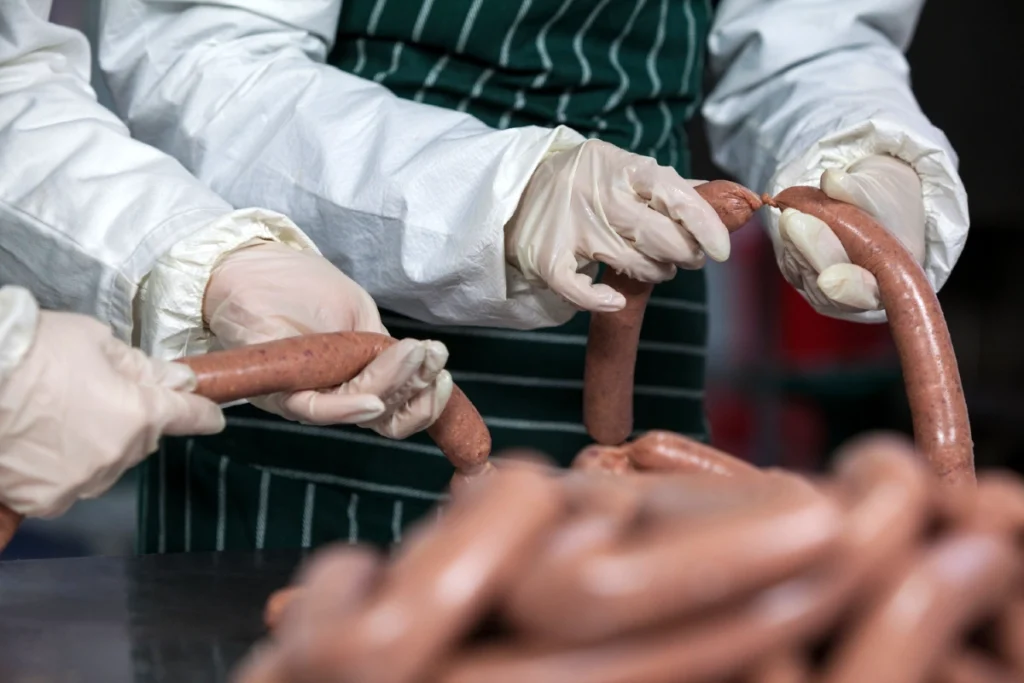
Common problems & solutions in sausage production of collagen casing

In sausage production using collagen casings, manufacturers may face several common challenges. Here are some of those problems along with their solutions:


1.  Casing Breakage or Rupture
  • Problem: Collagen casings can break or rupture during the stuffing or cooking process, resulting in the loss of product integrity.
  • Solution:
    • Ensure proper casing handling and storage.  Cases should be moist, not too dry or overly wet, as both extremes can affect their strength.
    • Use the correct stuffing equipment and avoid overstuffing the casings, which can cause pressure that leads to breakage.
    • Monitor cooking temperatures closely and ensure gradual heating to prevent thermal shock, which could cause rupturing.
2.  Inconsistent Casing Stretch
  • Problem: Collagen casings may not stretch uniformly, causing uneven sausage sizes and poor appearance.
  • Solution:
    • Ensure that casings are hydrated properly before use.
    • Check that the sausage stuffing machinery is set to the correct pressure and speed to allow consistent filling and stretching.
    • Use collagen casings with the appropriate stretch rating for the produced sausage type.
3.  Casing Separation or Peeling Off
  • Problem: Occasionally, collagen casings may peel off or separate from the sausage after cooking, leading to an unattractive appearance and poor quality.
  • Solution:
    • Adjust the cooking method.  Excessive moisture or cooking temperature that is too high can cause casings to separate.  Ensure that cooking is done at the proper temperature with controlled humidity.
    • Use a casing with the right degree of permeability for your sausage’s formulation.
    • Ensure proper casing treatment, such as using a casing binder or a therapy that helps casings adhere better.
4.  Overly Tight or Loose Casing
  • Problem: If the collagen casings are either too tight or too loose, they can affect the texture and look of the sausages.
  • Solution:
    • Maintain correct stuffing pressure and adjust the equipment to ensure that the sausage filling is distributed evenly and tightly, but not too much to cause splitting.
    • Select a casing size that closely matches the sausage diameter to avoid slack or tightness.
5.  Casing Discoloration
  • Problem: Collagen casings may discolor, especially during cooking or smoking.
  • Solution:
    • Ensure that cooking and smoking conditions are optimal.  Overexposure to high temperatures or certain smoking conditions can result in discoloration.
    • Use natural or bleached casings that match your production method and look preferences.
    • If discoloration occurs after packaging, consider adjusting the storage conditions to prevent further color degradation.
6.  Loss of Casing Moisture
  • Problem: If collagen casings lose moisture during processing, they can become brittle and difficult to handle.
  • Solution:
    • Keep the casings in an adequately moist environment before use, especially if stored in dry conditions.
    • Use proper casing lubrication during the stuffing process to maintain moisture levels.
7.  Improper Casings for Sausage Type
  • Problem: Not all collagen casings suit every sausage type, resulting in undesirable texture or finish.
  • Solution:
    • Choose the correct type of collagen casing based on the intended sausage style (e.g., fresh sausage vs. cooked or dry sausage).
    • Use appropriate casings that suit the size and texture requirements of your product.

Addressing these common issues can improve the production quality and consistency of collagen-cased sausages.

📩 Contact Us Today
📞 WhatsApp: +66 90 889 0666

News and Articles

Other News & Media